Showing posts with label News. Show all posts

Sunday, 7 August 2016

Escaping the sex trade: The stories of Nigerian women forced into prostitution in Italy in pictures... Must read!

Spanish photographer Quintin Valero took some striking visual record of the work being done by an NGO to help victims of sex trafficking in Asti, near Turin.
"What I found was a really strong community of women who were helping each other overcome their experiences, " she says
It’s just after 9pm when the first Nigerian women start to appear on the streets of Asti, a small city near Turin in northern Italy. Some stand in groups of two or three, flagging down passing cars or checking their phones. Many are alone – solitary figures backlit by the stream of headlights moving into the city, the Guardian UK writes.


Princess Inyang Okokon, a former victim of sex trafficking, slows down her car as she spots two girls standing on a corner. Even with heavy makeup they look no older than 15 or 16. “So many new faces,” she says, shaking her head as she pulls her car to the side of the road and gets out to speak to them.

Princess, a 42-year-old mother of four from Nigeria’s southern Akwa Ibom state,(pictured)  has spent the last 17 years working for Progetto Integrazione Accoglienza Migranti (PIAM), a migrant rights and anti-trafficking organisation in the city. According to her, most – if not all – of the Nigerian prostitutes working on Asti’s streets tonight are victims of trafficking.

"This is just one street in a small city. It is happening all over Italy and Europe and the numbers are growing and growing."
Princess knows first-hand about the horrors these women are living through. In 1999 she was trafficked herself from her home in Nigeria to the streets of Turin.
"When I talk to them I tell them that I know their story because it is my story too," she says.
For nearly three decades, a thriving sex-trafficking industry has been operating between Nigeria and Italy. Many experts believe the trade in women started in the 1980s when Nigerians travelling to Italy on work visas to pick tomatoes realised that selling sex was far easier and more profitable than harvesting fruits or vegetables.
Since then an estimated 30,000 Nigerian women have been trafficked from their home country into prostitution, finding themselves on street corners and brothels in Italy and other European states.

More than 85% of these women have come from Nigeria’s Edo state in the south of the country, where traffickers have historically exploited chronic poverty, discrimination, a failing education system and lack of opportunities for young women to sell false promises of prosperity in Europe.
Princess was one of the first wave of women to be brought from Nigeria. Then a single mother of three young children, she was approached by a woman she knew from her workplace, who offered her a job in Italy.
"We saw people come back from Europe rich and they would tell us that we could also have this life. In Nigeria there was nothing. I wanted more for my children. This woman said I could pay back the cost of my travel when I started earning. I believed her."
She flew to London on a fake passport. When she arrived she called a telephone number she’d been given and a man came to pick her up and drive her to Italy. She was taken to a house in Turin full of other Nigerian women. When she told them she was going to work in a restaurant, the women laughed in her face.
"They said, ‘Here no Nigerian girl works in a restaurant. Whether you are a princess or a queen you are here in Europe and you must work as a prostitute’. I was distraught, I thought there must be a mistake."
The next day Princess was told she had to pay back a €45,000 debt before she could leave. She was now under the control of a “madam”, a Nigerian woman who worked for the trafficking rings, controlling the women and their debt. She was given high heels and makeup and driven to a street corner with another Nigerian girl.
"I said ‘I will not do this,’" she recalls. "I refused. I hid behind a big rubbish bin all night and cried. I said, ‘God, is this the life you have brought me to?’"
After that night the beatings began. Her madam attacked her so violently with the heel of a shoe that she was hospitalised.
"I did not know anyone, they wouldn’t let me call home. They said they would kill me if I didn’t work,” she says. “I realised the only way was to start this work and try and find someone who would help me."
Every day and night for more than eight months, Princess worked on the streets in Turin.
"Italian men, they love Nigerian girls,” she says with a short laugh. “I had a queue every night."
 But no matter how hard she worked, her debts never got smaller.
"The work was so bad, it was so dangerous. The men were so violent. I was stabbed twice, I was threatened with a gun,” she says. "I was ashamed all the time. The only way I kept strong was promising myself I would leave this life."
Eventually, she says, her prayers were answered. She was walking home one morning when a man called Alberto Mossino pulled over in his car and asked if he could take her to the beach. Mossino, who was living in nearby Asti but working as a DJ in nightclubs in Turin, offered to help Princess leave her madam. “At first I didn’t trust him but then he helped me pay off my debts to my madam and I managed to leave that life. Since then he has been my partner in everything.

Princess’s life has changed since those days on the streets of Turin. She and Mossino moved to Asti, he started PIAM (she came on board later), and the couple married and had a daughter. (Of her four children, three are in Italy with her – the two oldest and Maria, her six-year-old daughter with Alberto. The other is studying in Nigeria.) She pursued her madam through the courts and eventually saw her sent to jail for four years.

Yet 17 years later she says the situation for other Nigerian women has become far worse than what she lived through. All the women on the streets of Asti have debts of more than €40,000 and most will have been forced to undergo ritual “juju” ceremonies where they have been told terrible things will happen to them and their families if they don’t repay what they owe.
"Those who leave Nigeria are told they will need to pay back €15,000 and when they reach Italy the madam tells them their debt is €45,000," says Princess. "Or they are told they will be able to pay back the debt in three months but when they arrive they must pay rent, for their place on the street, food and other costs, so they are trapped because the debt never goes away. These traffickers use beatings and juju to fill their victims with fear," she says. "The women believe the juju so much that I have seen women leave their traffickers and then go mad because they think the curse will come true. This is how powerful a hold it has over them."
Mossino, who works with refugees and asylum seekers as well as victims of trafficking, says that in the past decade the trade in Nigerian women has become a hugely profitable and ruthless criminal industry, controlled largely by Nigerian gangs that took root in Italy in the 1980s.
"Every woman represents hundreds of thousands of euros to these people," he says. "In Asti we saw 10 or 15 women a year when we started. Now we come into contact with 30 or 40 a month"
In the past women would have to be flown in to Europe with fake passports. Now they embark on the dangerous 2,500-mile journey overland through Africa and across Libya before making an equally hazardous crossing by sea to Italy on migrant boats.

In 2014 about 1,500 Nigerian women arrived by sea in Italy. In 2015 this figure had shot up to 5,633. The UN’s International Organisation for Migration (IOM) believes that 80% of these women are victims of trafficking.
"What we are seeing at the moment in terms of the numbers and scale of the criminal trade in Nigerian women is unprecedented,"  says Simona Moscarelli, an anti-trafficking expert at the IOM. "Before, the women were exploited but there was a chance that they could pay off their debts and be free. Now these girls really are slaves and subject to terrible violence. The age of the women is getting younger, to the extent that a large percentage of those arriving now are classed as unaccompanied minors when they come off the boats."
Loveth, a 21-year-old from Lagos, was only 17 when she left Nigeria. After being offered a job as a babysitter in Italy, she was instead forced to work in a brothel in Libya for three years.
"Before I went I was made to swear to the gods [in a juju ceremony] and they said if I didn’t pay back the money I wouldn’t be able to have babies and my life would be useless. Before they took me to Libya they used two boys to break my virginity and then they took me to Libya to a house and sent many men to sleep with me. They didn’t pay me, they just used me."
After being sold to another madam, Loveth refused to work and was beaten and had boiling water thrown on her legs. Eventually she was put on a boat to Italy with 95 other people.
"When I arrived in Italy I was very sick so they took me to the hospital and there I found out I was pregnant," she says. "That is when I knew the juju was a lie. After that I never worked as a prostitute again and PIAM has helped me get my life back."
Since PIAM was founded, Princess and Mossino have helped more than 200 women leave their traffickers in Asti and gain access to legal support, employment and counselling. They have also created refuges and communities for those kept isolated by their traffickers and who are hundreds of miles from home. Princess arranges for the women to live and work together.
"The trauma these women have gone through is very, very heavy," Princess says. "They need a family and a mother as well as the other things we can give them. At the weekends Princess helps organise parties and dances with the women. These traffickers take away everything from you, everything that makes you human. I want to give that back to these women and say to them, let us not rest until we have brought them all to justice."
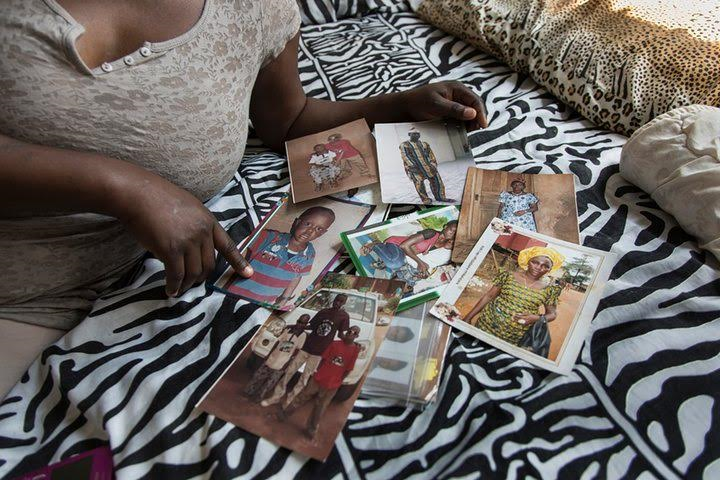
Below are photos of the former victims, their names and captions by photographer Quintina Valero.

 Princess Inyang Okokon, a former victim of sex trafficking, in a coffee shop in Asti, Italy. When she arrived in Turin in 1999, lured by the promise of work as a chef, traffickers demanded €45,000 to pay for the journey. She was forced into prostitution, but after eight months she managed to pay off her debt with the help of a priest and Alberto Mossino, an Italian who would become her husband. In 1999 Alberto set up an NGO to help migrants and women involved in trafficking in Italy – Princess came on board later. Since then, they have helped more than 200 women come out of prostitution.

Loveth, 21, in a shelter for victims of sex trafficking in Italy. Loveth had been forced into prostitution for four years in Libya after being raped by her traffickers. She was 17 when she left Nigeria. A madam had offered her work as a childminder in Europe. “Before they took me to Libya they used two boys to break my virginity and then in Libya they took me to a house and sent many men to sleep with me.

Precious, a 20-year-old Nigerian woman, in a bar in Asti, near Turin. In December 2014, six months after being rescued from the sea, she was granted a two-year humanitarian visa. She has also entered a protection programme. The SPRAR programme (System of Protection for Asylum Seekers and Refugees) was set up by the Italian government in 2002 and involves helping them to get accommodation, food, work, education and integrate themselves into Italian society. Precious now lives in an apartment, which she shares with four other victims of trafficking, and works in a shop in Astia.

Gift is welcomed to the shelter in Asti by Princess (far right) and her daughter Maria. She was removed by traffickers from the reception centre in Sicily soon after arriving in Italy from Nigeria (by boat). She managed to escape, reporting her madam and traffickers to the authorities, but even today her family back home get pressure about the debt. She will share the house with Patience (in red dress), a 30-year-old Nigerian woman who was sold by her friend to traffickers. Her friend had offered her a “good job” in Europe and the opportunity to provide money for her family and child.

Princess has helped to create a largely female community in Asti. This picture is of Gift, Loveth and Precious, all former victims of trafficking, having fun at the Christmas fair.

Victims of sex trafficking feel under immense pressure to protect their families back in Nigeria and superstition is a powerful tool for traffickers. The traffickers threaten victims with curses to procure their silence and cooperation. Victims have to pay off debts of between €45,000 and €60,000 for their travel arrangements. Before the women leave Nigeria, they have to swear to the gods that if they don’t pay back the debt for their journey something terrible will happen to them or their family.

 A Nigerian prostitute is given condoms by Princess. Once a week she drives with Mossino to the outskirts of Asti to meet prostitutes who are working on the road. She informs them of their rights and protection programmes available to them. She gives them information about the NGO and offers them help if they decide to leave the street.

 Success has recently reported her traffickers to the authorities after working as a prostitute in Asti for three years. Every month she had to give €200 to Jennifer, her madam, as rent for her space in the street, €250 as rent for the house where she slept – in the kitchen – and about €50 per week for groceries. “For other expenses such as electricity and gas, she asked me for about €300 per month. All that remained was to fill my debt of €50,000.” In December 2013 she felt sick, called an ambulance, and discovered in hospital that she was four months pregnant.

Sandra, a 21-year-old Nigerian woman washes her three-year-old son Destiny in a shelter in Monale, near Turin, which she shares with other victims of trafficking. Sandra is from Benin city in southern Nigeria. She left Nigeria when she was 18, and two months pregnant, because her family were very poor. A woman had offered her work abroad in a supermarket, but as soon as she arrived in Italy the woman she had travelled with took her to a forest, made her change her clothes and tried to force her work as a prostitute. Sandra refused and eventually a client helped her to escape.

Source: Guardian UK

Photos: Alleged Thief gets electrocuted while trying to steal cable in Niger state


The alleged thief got electrocuted while trying to steal cable from a transformer at Kontagora local government in Niger state today August 7th.  
 

Thursday, 4 August 2016

Check out this cute photo of Pres. Obama with an adorable little gir

l

White House Photographer Pete Souza shared this cute photo of President Obama and an adorable girl having a 'discussion' about the his real age. "55? Are you sure. My granddaddy told me you were 44." he captioned the photo

Photos: See what a father did to his 4-year-old daughter because she lost her slippers


According to a Facebook user who resides in Port Harcourt, the four year old girl was brutally beaten by her father for allegedly misplacing the slippers he bought for her. OMG! This man deserves to go to prison. How can you flog a 4 year old child like this?

Tuesday, 2 August 2016

Breaking News!!! Father Mbaka sends strong warning to Buhari


are on Twitter Mbaka
Read more: https://www.naij.com/913109-watch-father-mbaka-sends-strong-warning-buhari-speaks-niger-delta-crisis.html
Controversial Catholic priest Rev. Father Ejike Mbaka has sent a strong message to President Muhammadu Buhari in his latest sermon. Father Mbaka has blasted the incumbent president over the economic hardship destroying the country resulting from what he defined as poor leadership under the Buhari-led government. READ ALSO: How Rev. Ejike Mbaka Turned From Pro-Jonathan To Anti-Jonathan He stated that the president should know that Nigerians may vote him out in the next presidential election. The preacher said that Nigerians are clearly getting tired continuing that he campaigned against the ex-president Goodluck Jonathan because of the extensive corruption in the last administration in the hope that Buhari’s government would be better after his avowed declaration to fight corruption. According to Mbaka, “no nation could survive when the cankerworm of corruption eats deep into its social fabric as was witnessed in the past administration which informed his interest and desire to opt for a change.” He said: “The change which eventually came under the leadership of Buhari is not helping matters as poverty is ”smelling” in Nigeria. Landlords are lamenting while tenants are hungry and frustrated.” The fiery Catholic clergy also spoke on the agitation of militants in the Niger Delta especially the Niger Delta Avengers. Father Mbaka questioned the rationale for calling the Niger Delta Avengers criminals who are in fact fighting a just cause considering the degree of damage done to the region’s ecosystem which has been feeding the nation for decades. Watch the video below:
Read more: https://www.naij.com/913109-watch-father-mbaka-sends-strong-warning-buhari-speaks-niger-delta-crisis.html
Controversial Catholic priest Rev. Father Ejike Mbaka has sent a strong message to President Muhammadu Buhari in his latest sermon. Father Mbaka has blasted the incumbent president over the economic hardship destroying the country resulting from what he defined as poor leadership under the Buhari-led government.
He stated that the president should know that Nigerians may vote him out in the next presidential election. The preacher said that Nigerians are clearly getting tired continuing that he campaigned against the ex-president Goodluck Jonathan because of the extensive corruption in the last administration in the hope that Buhari’s government would be better after his avowed declaration to fight corruption.
According to Mbaka, “no nation could survive when the cankerworm of corruption eats deep into its social fabric as was witnessed in the past administration which informed his interest and desire to opt for a change.” He said: “The change which eventually came under the leadership of Buhari is not helping matters as poverty is ”smelling” in Nigeria. Landlords are lamenting while tenants are hungry and frustrated.” The fiery Catholic clergy also spoke on the agitation of militants in the Niger Delta especially the Niger Delta Avengers. Father Mbaka questioned the rationale for calling the Niger Delta Avengers criminals who are in fact fighting a just cause considering the degree of damage done to the region’s ecosystem which has been feeding the nation for decades. Watch the video

Controversial Catholic priest Rev. Father Ejike Mbaka has sent a strong message to President Muhammadu Buhari in his latest sermon. Father Mbaka has blasted the incumbent president over the economic hardship destroying the country resulting from what he defined as poor leadership under the Buhari-led government. READ ALSO: How Rev. Ejike Mbaka Turned From Pro-Jonathan To Anti-Jonathan He stated that the president should know that Nigerians may vote him out in the next presidential election. The preacher said that Nigerians are clearly getting tired continuing that he campaigned against the ex-president Goodluck Jonathan because of the extensive corruption in the last administration in the hope that Buhari’s government would be better after his avowed declaration to fight corruption. According to Mbaka, “no nation could survive when the cankerworm of corruption eats deep into its social fabric as was witnessed in the past administration which informed his interest and desire to opt for a change.” He said: “The change which eventually came under the leadership of Buhari is not helping matters as poverty is ”smelling” in Nigeria. Landlords are lamenting while tenants are hungry and frustrated.” The fiery Catholic clergy also spoke on the agitation of militants in the Niger Delta especially the Niger Delta Avengers. Father Mbaka questioned the rationale for calling the Niger Delta Avengers criminals who are in fact fighting a just cause considering the degree of damage done to the region’s ecosystem which has been feeding the nation for decades. Watch the video below:
Read more: https://www.naij.com/913109-watch-father-mbaka-sends-strong-warning-buhari-speaks-niger-delta-crisis.html
Controversial Catholic priest Rev. Father Ejike Mbaka has sent a strong message to President Muhammadu Buhari in his latest sermon. Father Mbaka has blasted the incumbent president over the economic hardship destroying the country resulting from what he defined as poor leadership under the Buhari-led government. READ ALSO: How Rev. Ejike Mbaka Turned From Pro-Jonathan To Anti-Jonathan He stated that the president should know that Nigerians may vote him out in the next presidential election. The preacher said that Nigerians are clearly getting tired continuing that he campaigned against the ex-president Goodluck Jonathan because of the extensive corruption in the last administration in the hope that Buhari’s government would be better after his avowed declaration to fight corruption. According to Mbaka, “no nation could survive when the cankerworm of corruption eats deep into its social fabric as was witnessed in the past administration which informed his interest and desire to opt for a change.” He said: “The change which eventually came under the leadership of Buhari is not helping matters as poverty is ”smelling” in Nigeria. Landlords are lamenting while tenants are hungry and frustrated.” The fiery Catholic clergy also spoke on the agitation of militants in the Niger Delta especially the Niger Delta Avengers. Father Mbaka questioned the rationale for calling the Niger Delta Avengers criminals who are in fact fighting a just cause considering the degree of damage done to the region’s ecosystem which has been feeding the nation for decades. Watch the video below:
Read more: https://www.naij.com/913109-watch-father-mbaka-sends-strong-warning-buhari-speaks-niger-delta-crisis.html

Monday, 1 August 2016

"kill one Christian and Government will kill four Muslims"....Kenya Delivers Brutal Justice to Radical Muslims After They Murdered Christians In The Name Of Jihad


Kenya delivered harsh punishment to over 100 radical muslims who hijacked a bus and tried to force Christians to recite Shadha, the Islamic creed. When they refused, all 28 Kenyan Christians were executed. Their reason was revenge for killing of their muslim brothers.
When the Kenya government was told what happened, the retaliation was phenomenal. The group of terrorists were hunted down and captured. They were told for every Kenyan Christian they murdered, four of them would be killed. There was no judge, no jury, no negotiation. Boom, boom, boom. They were all executed.
To make the message even more clear, the Kenyan military flew a few jets over a Jihadist camp killing all ninety-five. To sign, seal and deliver the message, Kenyan sent gunships and ground troops and executed twenty more.

Kenya government is experimenting with a new plan to deal with Jihads. It’s a four to one approach. For every twenty-give Kenyans that are murdered, one hundred Jihads will be executed. Liberals, no doubt will think this is harsh. They would rather let them all sit in jail, being housed, clothed and fed until a Judge decides if they are guilty or not. Then if they do happen to be found guilty, they would just be sent back to their own country where they can murder more innocent people. The rest of us however, find this a rather bold and satisfying solution. Let the punishment fit the crime. For every beheading, four of theirs should get the same. For every innocent person they chain in a cage and drop in water to drown, four of theirs should be subjected to the same. For every woman and child they assault, their penis should be cut off.
If we want to get this under control, all countries need to be more like Kenya. Forget about political correctness and compassion. We need to protect our citizens, our countries and do it in a language that these violent people understand. All we need are leaders and governments who don’t care what anyone thinks. When these Islamic terrorists see that they will be dealt with in the same manner they deal with others, it will either curb their behavior or they will be extinct. Personally, I prefer extinction as I see no way to reform their behavior. They are what they are and even military retaliation will not stop them. Something must be done.

Thursday, 30 June 2016

So Proud! 43 Of The 96 Howard Univrsity Doctor Of Pharm Candidates Are Nigerians


Nigerian students made us all proud last Saturday at Howard University in Washington D.C,. Of the 96 graduating Doctor of Pharmacy candidates, 43 of them were Nigerians!
Not only that, 27 awards were presented, and 16 went to Nigerians.
Also, more than 400 students received professional degrees in law, medicine, pharmacy and dentistry.

U.S. President Barack Obama delivered the keynote address at the event.
Howard University has the only dental and pharmacy colleges in the District of Columbia. The graduates represented 46 states and 35 countries. The youngest graduate at the ceremony was 20-years-old and the oldest was 74.

Thursday, 28 January 2016

Sweden plans to expel up to 80,000 asylum-seekers


Sweden intends to expel up to 80,000 migrants who arrived in 2015 and whose application for asylum has been rejected, Interior Minister Anders Ygeman said Wednesday.
"We are talking about 60,000 people but the number could climb to 80,000," the minister was quoted as saying by Swedish media, adding that the government had asked the police and authorities in charge of migrants to organise their expulsion.
The proposed measure was announced as Europe struggles to deal with a crisis that has seen tens of thousands of migrants arrive on Greek beaches, with the passengers -- mostly fleeing conflict in Syria, Iraq and Afghanistan -- undeterred by cold wintry conditions.
 
The UN says more than 46,000 people have arrived in Greece so far this year, with more than 170 people killed making the dangerous crossing.
 
Ygeman said the expulsions, normally carried out using commercial flights, would have to be done using specially chartered aircraft, given the large numbers, staggered over several years.
Sweden, which is home to 9.8 million people, is one of the European Union countries that has taken in the largest number of refugees in relation to its population. Sweden accepted more than 160,000 asylum seekers last year.
 
But the number of migrant arrivals has dropped dramatically since Sweden enacted systematic photo ID checks on travellers on January 4.

Swedish officials on Tuesday called for greater security at overcrowded asylum centres a day after the fatal stabbing of an employee at a refugee centre for unaccompanied youths.
The alleged attacker was a young male residing at a centre for youngsters aged 14 to 17 in Molndal near Gothenburg on Sweden's west coast.

The employee was 22-year-old Alexandra Mezher, according to Swedish media reports, whose family was originally from Lebanon. A motive for the attack was not immediately clear.
Her death has led to questions about overcrowded conditions inside some centres, with too few adults and employees to take care of children, many traumatised by war.
 
In neighbouring Denmark, meanwhile, the government this week approved legislation to seize the valuables of refugees in the hope of limiting the flow of migrants.


AFP

Thursday, 24 December 2015

Death Has Forgotten Me Says World's Oldest Man

Mahashta Mûrasi , the only man confirmed to have lived longest since the history of mankind, says that death has forgotten him.

The Indian, whom Guinness World Records recognises as the oldest man in the world lamented that his grandchildren had been dead for years and asked to know why death has eluded him despite his disturbing figure and looks.

Born in Bangalore on January 6, 1835, Murasi lived in Varanasi, where he worked until 1957 and retired at the age of 122 years.
“My grandchildren have died there a few years. In a way, death has forgotten me. And now I have lost all hope to die,” he said.World news daily report confirmed that all official documents to identify this man and support the claims are available.
Meanwhile, contradictory reports surfaced online, suggesting that the man who claimed to be the oldest is a shoe cobbler and is not as old as he claimed to be.
It is now confirmed that the oldest person on record, whose age was well documented, was Jeane Calment of France, who reached the age of 122 and died in 1997.

Baby Girls Born With Their Heads Fused

Twin sisters have been born joined at the head in Banda Aceh, Indonesia. The onjoined baby girls were born prematurely by emergency caesarean section suffering from the extra rare condition that occurs in about one in 2.5 million births. 
Sisters Putra and Siti Hadijah are currently in a hospital , fighting for their lives. As separating them can be dangerous, the best hospital medics are trying to establish whether the girls share brain tissue, as well as vital arteries and nerves. Conjoined twins who are fused at the skull are called craniopagus twins.
Twin baby girls Putra and Siti Hadijah were born conjoined at the head at an Indonesian hospital
READ ALSO:
In the last-half century the many advances in medicine have proven that a successful outcome is possible following separation of total craniopagus twins. However, most cases of separation are extremely risky and life-threatening. In many cases, the surgery results in the death of one or both of the twins, particularly if they are joined at the head or share a vital organ.
The conjoined twins are currently being cared for in Zainal Abidin Hospital’s Neonatal Intensive Care Unit (NICU) in Indonesia
Around 200 pairs of conjoined twins are born alive every year. Only half of the twins survive past their first birthday. Approximately 70 percent of all conjoined twins are girls. Female siblings are more likely to survive than their male counterparts. Earlier this year conjoined baby twin girls who shared the same chest wall, lungs, pericardial sac, diaphragm, liver, intestines, colon and pelvis were separated in the world’s first successful operation of its kind.
Designed by Kaesy Nwosu